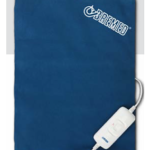
You can buy a heat pad on Shopee for fifteen dollars. Ours is around seventy. We sell one of these, so here is the comparison with our thumb visible on the scale, and the parts where the cheap pad genuinely wins.
Where a cheap pad is the right buy
- You want to find out whether heat helps you at all. If you’re not sure heat is even right for your problem, spending seventy dollars to test it is silly. Read heat or ice first, then buy cheap and find out.
- You need something today for a short-lived problem. A week of post-gym soreness doesn’t need a pad that lasts three years.
- Budget is the binding constraint. A cheap pad used carefully beats no pad. We’d rather say that than pretend otherwise.
What the extra money buys
Temperature that holds. This is the difference that matters and the one you can’t see in a listing. A pad that swings between too hot and cooling off never settles into the range where muscle relaxes, and it keeps crossing into the range that damages skin. The useful band and the damaging band are only a few degrees apart: what temperature should a heating pad be?
A known failure mode. We’ve supplied the same pad since 2010, somewhere north of 2,000 units. When one reaches the end, at eighteen to thirty-six months, it stops switching on. That’s what comes back to us: not hot spots, not scorching. The full data is in our long-term review.
That matters because the failures that hurt people are the ones that keep working badly. A thinned element with a hot patch, a cord that heats where it’s cracked. Those are real across the category and we describe them in what to check when a pad stops heating properly. With an unbranded pad you have no idea which way yours will go, because nobody is tracking it.
A removable, washable cover. Cheap pads often have a fixed cover or none. That decides whether a pad is still in use in year two or sitting in a drawer: how to wash a heating pad cover.
Someone local who answers. A warranty is worth the effort of claiming it, and an overseas listing that stops replying after the return window is not a warranty.
The arithmetic
A pad you replace yearly costs more over five years than one at three times the price that lasts two to three. That’s the ordinary case, and it’s not a strong one on its own, because plenty of cheap pads do last.
The stronger case is what the thing does while it’s working. This is an appliance you hold against bare skin, for twenty minutes, often on someone elderly, unwell or half asleep. It’s not a category where the bottom of the market is a bargain in the way a phone cable is.
What to check on any cheap listing
- A rating label with voltage, wattage and a model number. 220–240V, not 110V. No label at all is the clearest warning sign there is.
- Dimensions in writing, not just in a photo. Too small is the most common buying mistake: which size for which body part.
- Whether the cover comes off. If the listing doesn’t say, assume it doesn’t.
- The one and two star reviews only. On this product they cluster: uneven heat, a controller that dies, a cord that frays.
- A local seller, and whether they answer a question before you buy.
- Budget for a proper fused adapter if it has a 2-pin plug, and buy that from a hardware shop rather than adding a two-dollar one to the cart. The adapter is often the weakest link in the whole setup: using a 2-pin plug heat pad safely and what the Safety Mark means.
Fuller version of the price question: how much should a heat pad cost in Singapore?
Things the price doesn’t change
An expensive pad is not safer to fall asleep on, does not treat any condition, and does not make heat the right choice for a problem that needs cold. It also won’t help a swollen fresh injury, nerve pain, or anyone who shouldn’t be using heat at all.
Read who should not use a heating pad before you spend anything. If you’re in that list, the money is better spent on an assessment.
What we’d tell a friend
Buying for yourself, for an occasional stiff back, and you already know heat works for you: any decent mid-range pad with a washable cover and a rating label is fine. Apply the checklist in what a physio looks for in a heating pad and buy whatever passes it.
Buying for daily use, for elderly parents, or for a clinic where it runs eight hours a day: buy the one with a known failure mode and a local number. That’s the argument for ours, and it’s the only one we’d make.
Ordering several: heat pads for clinics, gyms and physiotherapy practices. Where each channel stands: where to buy a heat pad in Singapore.
The heat pad we use
We’ve supplied the Bremed BD7800 since 2010. It holds a steady temperature, covers a whole lower back and has a machine-washable cotton cover. Physiotherapy clinics in Singapore use it with their patients.
Clinically reviewed by: Nigel Chua (Hand Occupational Therapist) & Louise Yow (Physiotherapist). This article is general information, not a diagnosis. electricheatpad.com sells electric heat pads.