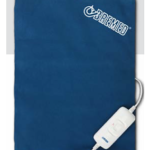
Every heat pad warning list says “not on broken skin”. That’s easy to follow if your skin is normally fine and you’ve got one graze. It’s less useful if you have eczema or psoriasis and your skin is somewhere on that spectrum most of the time.
So here’s the practical version.
The rule, in order
- Skin broken, weeping, cracked, infected or freshly flared: no pad on that area. Treat the skin first.
- Skin intact but dry, thickened or discoloured from old patches: a pad is reasonable, with extra care below.
- The sore muscle is somewhere your skin is clear: no different from anyone else.
The general list is in who should not use a heating pad.
Heat and itch
Warmth makes itch worse. Most people with eczema know this already from getting into bed, or from a hot shower that felt wonderful and then set the itch off for an hour.
Sweating under a pad adds to it. So even where the skin is intact, a pad over an eczema-prone area can buy you twenty comfortable minutes for your back and an evening of scratching, which is a poor trade. Scratching breaks the skin, and broken skin is where infection starts and the cycle restarts.
If that’s your pattern, put the pad somewhere else, or use a warm shower over the muscle instead and get out before you overheat: moist heat vs dry heat.
Creams and heat don’t go together
Don’t apply a steroid cream, calcineurin inhibitor or any prescribed topical and then put a heat pad over it. Warming skin increases how much of an applied product passes through it, and these are medicines with dose-dependent effects.
Leave a clear gap, or use the pad on a different area. The same reasoning, spelled out, is in deep heat rubs and heating pads.
Emollients are less of a medicine and more of a barrier, and they’re not a reason to avoid heat by themselves. Still, a thick greasy layer under a warm pad traps heat against skin and makes a cotton cover unpleasant fairly quickly. Moisturise after the session rather than before.
Thin and fragile skin
Skin gets thinner with age, after long-term steroid use, and in some medical conditions. Thin skin burns at lower temperatures and heals more slowly, and it doesn’t advertise itself the way a wound does.
- Add a folded towel between the cover and your skin. Two layers, not one.
- Lowest setting, 10 minutes rather than 20. See how long to use a heating pad.
- No pressure. Don’t lie on the pad, and don’t strap a wrap tightly over fragile skin: heated wraps vs a flat pad.
- Look at the skin afterwards, every time. Redness that hasn’t faded within an hour means shorter and cooler next time.
- Move the pad around. The same patch of skin heated daily for months develops a lasting mottled discolouration: toasted skin syndrome.
For older relatives this is usually the deciding factor rather than the pain itself: safe heat at home for elderly parents.
Psoriasis, and the trauma question
Psoriasis can appear at sites of skin injury, which is why friction, scratching and burns are worth avoiding rather than shrugging at. A pad used sensibly on intact skin isn’t skin injury. A pad that leaves you red for hours, or a patch you’ve scratched raw afterwards, is a different matter.
Psoriasis also comes with joint pain for a proportion of people, and stiff joints in the morning are exactly what heat helps. If that’s you, work around the plaques rather than over them, and see heat for knee and joint pain, hand arthritis and rheumatoid arthritis, which follows a similar pattern of stiffness versus flare.
See a doctor if…
- Skin is weeping, crusted, painful or spreading, which can mean infection
- You have a fever alongside a flare
- A patch of skin doesn’t settle after you stop using heat on it
- You develop blistering, or redness that lasts more than a few hours after a session
- Joints are swelling or stiff in the morning alongside psoriasis. Psoriatic arthritis is treatable and better caught early.
Clinically reviewed by: Nigel Chua (Hand Occupational Therapist) & Louise Yow (Physiotherapist). This article is general information, not a diagnosis. electricheatpad.com sells electric heat pads.