Heat pads in Singapore run from around ten dollars to well past a hundred.
The listings sometimes look similar, the photos are often the same stock image, and nothing on the page explains the gap.
Here’s what the money actually buys.
We sell one pad, so treat this as a supplier being upfront about where the price differences come from. For our current price, check the listing. Prices move; articles don’t. Where to buy a heat pad in Singapore covers the channels.
What the bands look like
| Roughly | What you tend to get |
|---|---|
| Under $20 | Small unbranded pads, thin fabric, often no removable cover, no local warranty. Some have no SAFETY Mark. |
| $20 to $50 | The bulk of the market. Full-size pads, usually a washable cover, mixed quality of temperature control. |
| $50 to $100 | Steady thermostatic control, better covers, a real warranty and someone local to call. |
| Above $100 | Usually shaped wraps, branded wellness products, or pads charging for infrared and stone claims. |
On the first row, the mark is worth checking before anything else: what the Safety Mark means. On the last, heated wraps vs a flat pad. And for the cheap-versus-better question in full, what the difference actually buys you.
What you’re paying for
Temperature control. The single biggest difference, and the hardest to see in a listing. A cheap pad cycles: hot, cooling, hot again. A good one holds the setting. That matters because the useful range sits a few degrees below the range that damages skin, and a pad that overshoots keeps crossing into it.
The cover. A removable, machine-washable cotton cover is the difference between a pad you use for years and one that gets shoved in a drawer after six months. See how to wash and care for it.
Wiring and build. The heating element and its wiring are what fail. You can’t inspect them, which is why brand and warranty stand in as proxies. See how long a heat pad lasts and what failure looks like.
Local support. A warranty is only worth the effort of claiming it. A local seller who answers is worth more than a longer warranty from an overseas listing that stops replying after the return window closes.
What you’re not paying for
- Infrared, jade and tourmaline claims. Deeper penetration and detox effects aren’t well supported. See infrared vs electric heating pads.
- A high maximum temperature. You should be using the lowest setting that helps. A higher ceiling is not a better product. See what temperature should a heating pad be?
- Ten heat settings. Two or three, clearly labelled, are easier to use well.
- Treatment claims. Heat eases stiffness and pain while it’s on. A pad that says it cures anything is selling you a sentence, not a feature. What heat does and doesn’t do: hot compress vs cold compress.
The cheap pad arithmetic
A pad you replace every year costs more over five years than one that lasts, even at three times the price. That’s the ordinary case for buying better.
The less ordinary case is the safety one.
The failures that matter with heat pads are a heating element that develops a hot spot and wiring that frays where the cord meets the pad. Both are more likely in cheap construction, both are invisible until they aren’t, and both sit against your skin for twenty minutes at a time.
This is not a category where the bottom of the market is a bargain.
Costs people forget
- An adapter. Many pads sold here, ours included, have a 2 round-pin plug. Budget for a proper fused adapter. See using a 2-pin plug heat pad safely in Singapore.
- A spare cover, if more than one person in the house will use it.
- Delivery, which can be a fifth of the price of a cheap pad.
- Electricity, which is the one cost that genuinely doesn’t matter. A pad draws less than a kettle and runs twenty minutes at a time. The figures: what a heat pad costs to run.
Reusable alternatives with no running cost at all, and their own trade-offs: electric vs microwave vs stick-on heat packs and hot water bottle vs heating pad.
Before you pay
Check three things on the listing: the dimensions against the body part you’re treating, whether the cover comes off, and whether there’s a local number to call if it fails.
The full checklist is in what a physio looks for in a heating pad, and the sizing in which size heat pad for which body part. On the pad we stock, and how they hold up over years: our long-term review.
Buying several for a clinic, gym or office? Different pricing and a different conversation: heat pads for clinics, gyms and physiotherapy practices, or for staff gifts, corporate heat pad gifting.
The heat pad we use
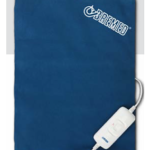
We’ve supplied the Bremed BD7800 since 2010. It holds a steady temperature, covers a whole lower back and has a machine-washable cotton cover. Physiotherapy clinics in Singapore use it with their patients.
Clinically reviewed by: Nigel Chua (Hand Occupational Therapist) & Louise Yow (Physiotherapist). This article is general information, not a diagnosis. electricheatpad.com sells electric heat pads.